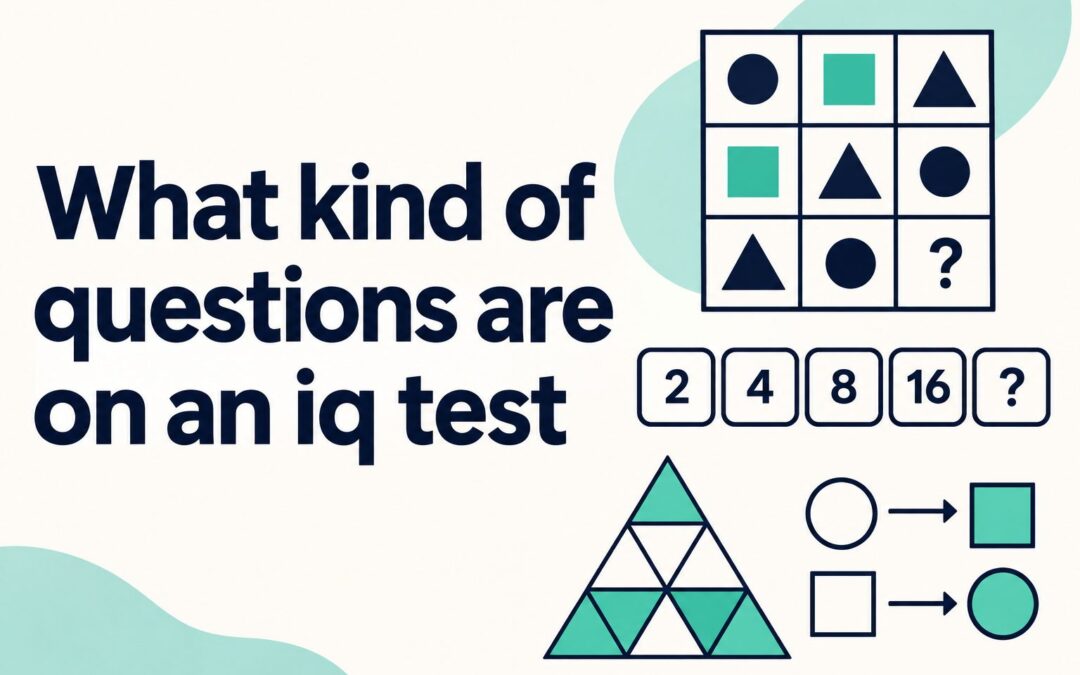
What Kind Of Questions Are On An IQ Test
If you are wondering what kind of questions are on an IQ test, you will usually find a mix of puzzles that measure reasoning, pattern recognition, memory, language skills, and problem-solving. IQ tests are not school exams that ask you to memorize facts. Instead, they look at how you process new information, spot relationships, and work through unfamiliar tasks. A test may include words, numbers, shapes, pictures, or timed challenges. The exact format depends on the test and the age of the person taking it. Knowing what to expect can make the experience less stressful and help you approach each question calmly. This guide explains the main question types, why they are used, examples of how they work, common mistakes, and practical ways to prepare.
What IQ Tests Are Designed To Measure
IQ stands for intelligence quotient, but a score does not capture every ability a person has. Most professionally designed IQ tests assess several thinking skills and compare performance with that of people in a similar age group.
Reasoning is a major focus. You may be asked to identify a rule, decide what follows logically, or choose the item that completes a sequence. These questions show how well you can analyze information without relying only on prior knowledge.
Many tests also measure verbal comprehension. This involves understanding words, explaining ideas, and recognizing how concepts are related. Vocabulary can matter, but the goal is usually to assess how you use language to reason.
Visual and spatial thinking are common areas as well. These tasks use shapes, blocks, diagrams, or pictures. They test whether you can mentally rotate an object, recognize a pattern, or see how separate pieces fit together.
Working memory and processing speed may also appear. Working memory involves holding information in mind while using it, such as repeating numbers backward. Processing-speed tasks check how efficiently you can complete simple visual or written tasks under time limits.
Common IQ Test Question Types
1. Number Sequences
Number sequence questions present a list of numbers and ask what comes next. For example, a sequence might increase by the same amount each time, alternate between two rules, or use multiplication and subtraction. The challenge is not advanced mathematics. It is recognizing the relationship between the numbers and testing whether that pattern remains consistent.
2. Shape Patterns
Shape pattern questions use symbols, figures, or pictures that change according to a rule. A shape may rotate, gain a side, switch color, or move to a different position. You are asked to select the next image or identify the missing one. These questions are common because they reduce the effect of language and school knowledge.
3. Analogies
An analogy asks you to identify a relationship between two things and apply that relationship to another pair. A simple example is “bird is to nest as bee is to what?” The answer is “hive.” More difficult analogies may involve abstract words or less obvious connections. They measure verbal reasoning, concept formation, and flexible thinking.
4. Classification Questions
Classification questions ask which item does not belong in a group. You might see several words, numbers, or images and need to identify the odd one out. Success depends on noticing the shared feature among most choices. Sometimes more than one relationship seems possible, so the best answer is usually the one supported most clearly by all the information.
5. Matrix Reasoning
Matrix reasoning questions often show a grid with one missing square. Each row and column follows a visual rule involving movement, shape, number, size, shading, or orientation. You select the option that completes the grid. These are among the best-known IQ-style questions because they measure nonverbal reasoning and pattern detection.
6. Spatial Rotation Questions
In spatial rotation tasks, you see a shape and must decide which option shows the same shape turned in a different direction. Some options may be mirror images, which are not the same as rotations. These questions test visual imagination and the ability to manipulate objects mentally.
7. Word Meaning Questions
Verbal IQ sections may ask for definitions, synonyms, antonyms, or the best word to complete a sentence. A question may also ask how two words are alike. For example, you could be asked what a bicycle and a boat have in common. The expected answer might focus on the broader idea that both are forms of transportation.
8. Logic Problems
Logic questions provide a short set of facts and ask what must be true, could be true, or cannot be true. They may involve seating arrangements, order of events, or rules about categories. The key is to rely on the information given rather than assumptions that feel reasonable.
9. Memory Questions
Memory tasks may require you to repeat a list of digits, words, or visual items. In more challenging versions, you repeat them in reverse order or arrange them from lowest to highest. These questions assess working memory, which supports learning, attention, and multi-step reasoning.
10. Coding And Symbol Questions
Coding questions pair symbols with numbers or shapes and ask you to copy the correct pair quickly. They are usually timed. The goal is to measure attention, accuracy, visual scanning, and speed rather than deep reasoning. A person can understand the rule completely but still lose points by working too slowly.
Examples Of IQ Test Questions
1. A Simple Number Pattern
Consider the sequence 3, 6, 9, 12, __. The next number is 15 because the pattern adds three each time. Real IQ tests can be more complex, but the same approach applies: look for changes between items before guessing the overall rule.
2. An Alternating Pattern
A sequence such as 2, 5, 3, 6, 4, 7, __ uses two patterns at once. One set rises from 2 to 3 to 4, while the other rises from 5 to 6 to 7. The next number is 5. Alternating patterns are easy to miss when you rush.
3. A Verbal Analogy
A question might say, “Book is to reading as fork is to __.” The answer is “eating.” The relationship is based on function. To solve analogies, first describe the link between the original pair in a short phrase, then apply that phrase to the second pair.
4. An Odd-One-Out Question
You might see square, triangle, circle, rectangle, and apple. The apple is the answer because the other choices are geometric shapes. In harder questions, the difference may involve category, use, number of sides, or a hidden mathematical rule.
5. A Matrix Puzzle
Imagine a three-by-three grid where each row contains one small circle, one medium circle, and one large circle. If the missing space should contain the large circle to complete the pattern, that option is correct. Look across rows and down columns before selecting an answer.
6. A Spatial Task
A folded paper shape may be shown with a hole punched through it. You are asked what the paper looks like after it is unfolded. This type of question tests your ability to visualize changes in shape and position without physically handling the paper.
7. A Logic Statement
Suppose every red object is round, and some round objects are heavy. You cannot conclude that every red object is heavy. The information only tells you that red objects belong to the group of round objects. Logic questions reward careful reading, not intuition.
Why These Questions Matter
IQ test questions are designed to sample different mental abilities instead of measuring one narrow skill. A person may perform strongly on verbal reasoning but find visual speed tasks difficult, or the reverse may be true. Looking at separate areas can provide more useful information than focusing only on one overall score.
In educational settings, professionally administered assessments can help identify learning strengths, giftedness, or support needs. For example, a large difference between verbal reasoning and processing speed may encourage a school professional to investigate whether extra time or another accommodation would be helpful.
Psychologists may also use cognitive testing as part of a broader evaluation. The results are interpreted alongside personal history, school performance, health factors, behavior, and other assessments. An IQ score alone should never be treated as a complete explanation of someone’s abilities or potential.
For personal curiosity, practice questions can be enjoyable brain exercises. They may help you discover whether you prefer word puzzles, visual patterns, logic games, or numerical challenges. However, informal online quizzes should be treated as entertainment unless they are properly standardized and administered.
How To Approach IQ Test Questions
1. Read The Instructions Carefully
Each section may use a different rule, and a quick assumption can lead to avoidable errors. Take a moment to identify exactly what the question asks. Pay attention to whether you need the next item, the missing item, the best match, or the option that does not fit.
2. Look For The Simplest Rule First
Patterns often follow a clear rule involving addition, rotation, repetition, or progression. Before searching for an unusual explanation, test the most direct possibility. A good answer should account for every item shown, not only the last two items.
3. Break Complex Problems Into Parts
For visual questions, examine one feature at a time: shape, size, direction, number, position, or shading. For word questions, identify the category or relationship. Breaking a puzzle into smaller parts makes it much easier to see the rule.
4. Manage Your Time
Timed sections reward steady progress. If a question is taking too long, make your best choice if guessing is allowed and move on. Spending several minutes on one difficult item can prevent you from answering easier questions later in the section.
5. Avoid Overthinking
Some people invent highly complicated rules because they assume every question must be tricky. While difficult questions exist, test designers generally expect one logical solution. If your explanation requires several exceptions, it is probably not the intended pattern.
6. Use Elimination
When unsure, remove options that clearly violate the visible rule. In multiple-choice questions, eliminating even two choices improves your odds and may reveal the answer. This is particularly useful for matrix and spatial-reasoning tasks.
7. Stay Calm After A Difficult Item
A hard question does not mean you are doing poorly. Most standardized tests include items of varying difficulty. Treat each new question as a fresh task, and do not let one confusing puzzle affect your pace or confidence.
Common Mistakes To Avoid
1. Treating An IQ Test Like A School Exam
Studying facts, dates, or advanced formulas is usually not the main goal. While language and learned knowledge can affect some sections, many questions focus on reasoning with unfamiliar information. Practice the format rather than trying to memorize a large collection of answers.
2. Ignoring Time Limits
People sometimes focus only on getting every answer right and forget that speed may be part of the score. Practice working efficiently without sacrificing basic accuracy. Learn when to pause for a second look and when to move forward.
3. Assuming One Score Defines Intelligence
IQ tests measure selected cognitive abilities under specific conditions. They do not fully measure creativity, practical wisdom, emotional skills, perseverance, artistic talent, motivation, or character. A result can be informative, but it is not a label for a person’s total worth.
4. Relying On Unreliable Online Tests
Many online quizzes use dramatic score claims without sound scoring methods, age comparisons, or clear norms. They may be fun practice, but they are not equivalent to an assessment given and interpreted by a qualified professional.
5. Practicing Only One Type Of Puzzle
Someone who completes only number sequences may feel unprepared for visual, verbal, and memory questions. A balanced approach includes several question types. This helps you recognize your stronger areas while becoming more comfortable with unfamiliar formats.
6. Letting Anxiety Control The Test
Stress can make simple questions feel confusing, especially in timed conditions. Rest well, read directions slowly, and use a calm pace. If the assessment has an important purpose, ask beforehand what the process will involve and whether breaks are available.
Best Practices For Preparing
1. Familiarize Yourself With The Format
Reviewing sample questions can reduce surprise and help you recognize common task types. The goal is not to memorize specific answers. It is to learn how patterns, analogies, matrices, and timed coding tasks are presented.
2. Practice Short Sessions
Brief, focused practice is often more useful than exhausting study sessions. Work on a few visual, verbal, and numerical puzzles at a time. Then review why each answer works so you learn the reasoning process rather than just checking a score.
3. Build A Clear Problem-Solving Routine
For every question, identify the information, search for a rule, test it against all examples, and then choose the option that fits. A consistent routine reduces careless mistakes and helps you stay organized when questions become more difficult.
4. Protect Sleep And Focus
A good night’s sleep supports attention, memory, and processing speed. Eat normally, arrive on time, and avoid trying to solve difficult puzzles immediately before an important assessment. Clear thinking usually helps more than last-minute cramming.
5. Ask About The Purpose Of The Test
A school screening, clinical evaluation, job-related assessment, and recreational quiz are not the same thing. Knowing why the test is being used helps you set realistic expectations and understand whether a professional interpretation will be provided.
6. Review Results In Context
If you receive results from a formal test, discuss them with the qualified person who administered it. Ask what the different areas mean, what may have influenced performance, and whether the findings suggest useful next steps for learning or support.
Frequently Asked Questions
1. Are IQ Test Questions Mostly Math Questions?
No. Some IQ tests include number patterns and basic quantitative reasoning, but they are not mainly math exams. Many questions involve words, shapes, logic, memory, or visual patterns. Advanced mathematics is usually unnecessary unless a specific test is designed for a specialized purpose.
2. Do IQ Tests Measure General Knowledge?
Some assessments include vocabulary or general-information questions because learned knowledge can reflect verbal development. However, many sections deliberately use unfamiliar patterns and nonverbal problems. This allows the test to measure reasoning skills without depending entirely on what a person has learned in school.
3. Can You Improve At IQ Test Questions?
You can improve familiarity, pacing, and confidence through practice. Learning to recognize common puzzle formats can reduce careless errors. However, practice effects do not mean every test score represents a permanent change in intelligence, and formal assessments are designed to limit simple memorization.
4. Are Online IQ Tests Accurate?
Most online IQ tests are not suitable for clinical, educational, or employment decisions. They may lack representative comparison groups, consistent conditions, and professional interpretation. They can still be useful for casual practice, but their results should not be treated as a definitive measure of ability.
5. What Is The Hardest Type Of IQ Test Question?
The hardest type varies by person. Some people find abstract visual matrices challenging, while others struggle with timed coding tasks or verbal analogies. Difficulty also changes as questions become more complex, so a challenging item may simply be testing the upper range of a skill.
6. Should Children Practice Before An IQ Test?
Parents should follow the guidance of the qualified professional arranging the assessment. Light familiarity with the setting may reduce anxiety, but intensive coaching can make results less useful. The purpose of many child assessments is to see how the child naturally approaches different thinking tasks.
Conclusion
The answer to what kind of questions are on an IQ test is broad: expect number patterns, visual puzzles, analogies, logic tasks, memory exercises, spatial questions, and timed symbol activities. Each type is intended to examine a different part of cognitive performance.
The most helpful approach is to stay calm, read carefully, look for clear rules, and keep the results in perspective. An IQ test can offer useful information about certain thinking skills, but it is only one part of the much larger picture of human ability.